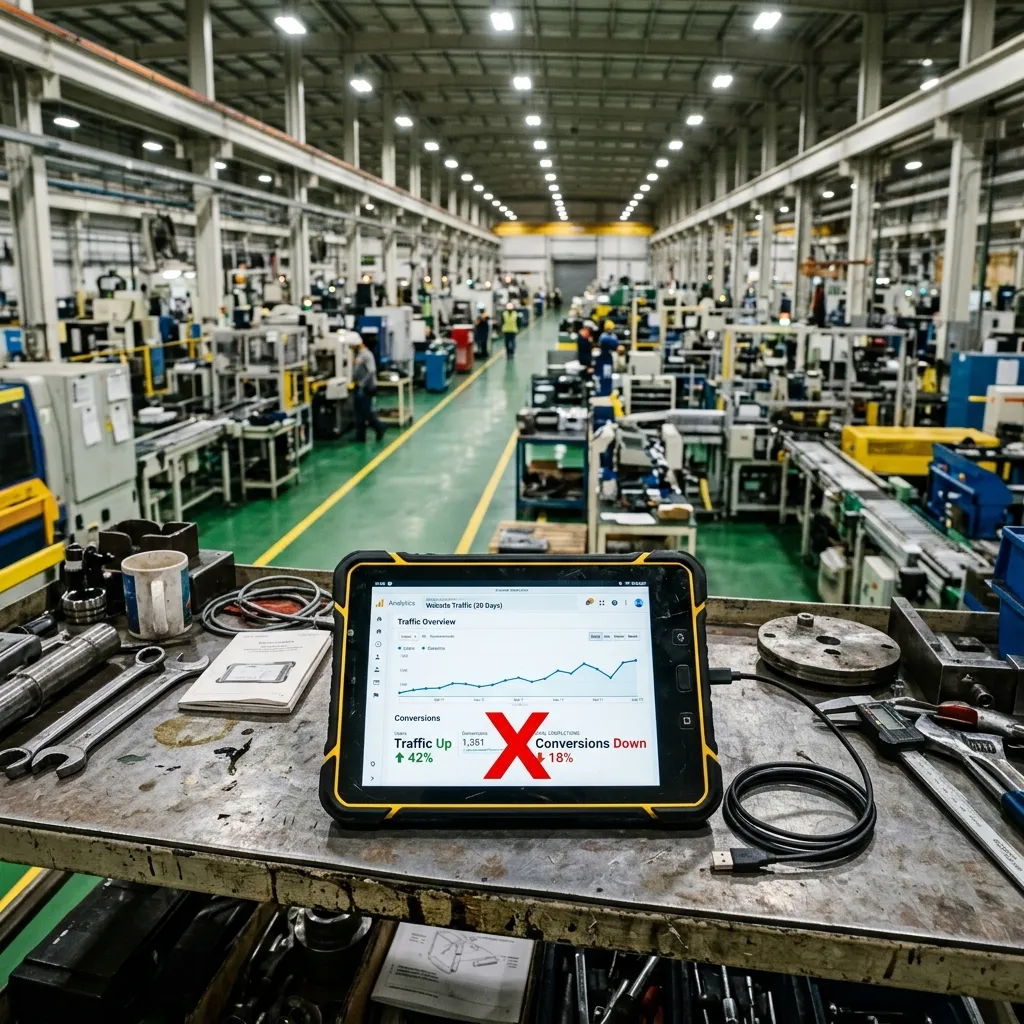
Here is a number that should bother you: the average industrial B2B website converts less than 1% of its traffic into inquiries. Some convert less than 0.3%.
This means that for every thousand visitors your SEO efforts bring in, 990 of them leave without doing anything. They looked at your homepage, maybe clicked into a product page, and then disappeared. You paid for that traffic — in development costs, in content production, in months of SEO optimization — and got almost nothing back.
The instinct is to blame the traffic. “We need better keywords,” or “our visitors aren’t qualified.” Sometimes that is true. But more often, the traffic is fine. The visitors are real procurement professionals, engineers, and sourcing managers who arrived with genuine intent. They left not because they were the wrong audience, but because your website did not give them a reason to stay.
The gap between interest and action
Think about what it takes for a corporate buyer to submit an inquiry to a supplier they have never worked with. They are not just giving you their email address. They are initiating a process that will involve their engineering team, their compliance department, their logistics coordinator, and eventually their CFO. Every inquiry is a professional commitment.
Now look at what most industrial websites offer in return for that commitment: a blank contact form with five empty fields and the word “Submit.”
There is an enormous gap between what you are asking the buyer to do and what you are offering them in return. This gap is where inquiries die.
What closes the gap
The websites that convert well do something specific: they make the inquiry feel like a valuable exchange, not a one-sided request.
Instead of “Contact Us,” they say: “Submit your application parameters and receive a preliminary feasibility assessment within 48 hours.” Instead of a blank text area, they provide structured fields that help the buyer articulate their needs clearly — material type, tolerance requirements, target volume, delivery region.
This reframing works because it addresses the buyer’s core anxiety: “If I submit this form, will anything actually happen? Or will I just get added to a newsletter list?”
When you promise a specific, valuable response within a defined timeframe, you transform the form from a cost (giving up personal information) into an investment (receiving expert analysis). That single shift can double or triple conversion rates.
But the form is only the last step
Form optimization matters, but the real conversion work happens before the buyer ever sees the form. It happens on the product page that demonstrated you understand their application. It happens on the case study that proved you have done this before. It happens on the trust page that showed your certifications are current and verifiable.
Conversion is not a moment. It is an accumulation of evidence that makes the inquiry feel safe.