
TC vs TE Series
Which One Fits Your Warehouse?
Choosing between the TC series and the TE series is the single most important decision when specifying a telescopic cantilever rack system. Both share the same rack-and-pinion drivetrain and deliver the same core benefit — single-person, crane-accessible storage of heavy long materials — but they differ fundamentally in structure, logistics, and ideal use case. This guide gives you everything you need to make the right call.
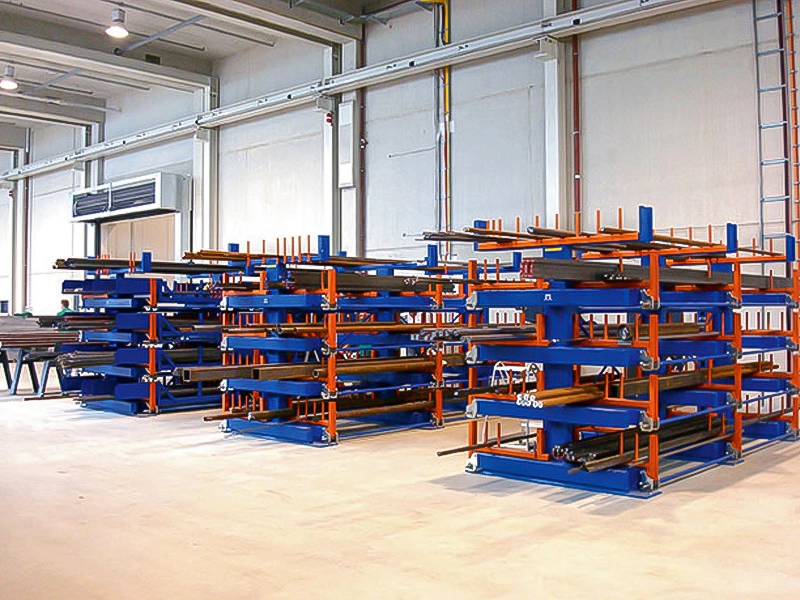
The Quick Visual Test: X-Bracing vs. Horizontal Bracing
You can tell the two series apart at a glance by looking at the bracing between the uprights:
- TC Rack → X-shaped cross bracing. The diagonal members form an “X” pattern between columns, leveraging triangular stability for maximum rigidity.
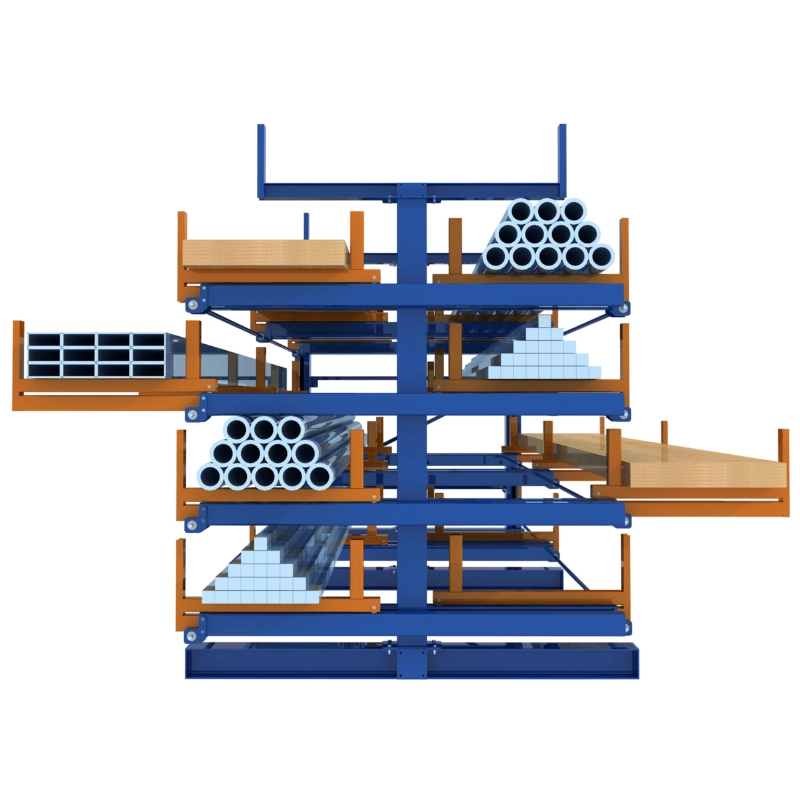
- TE Rack → Horizontal bracing. The braces run horizontally in a ladder-like pattern between paired upright columns, creating a modular, layered structure.
The second visual cue is the upright itself. TC uses a single welded column with arms on both sides. TE uses a double upright — two smaller column sections with the cantilever arm mounted between them on precision brackets.
TC Rack: The Welded Workhorse
How It’s Built
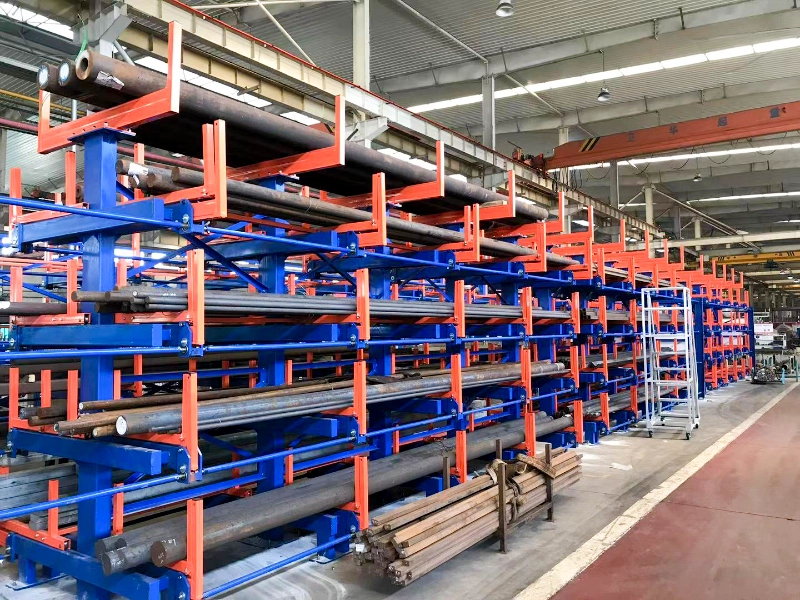
In the TC series, every cantilever arm is fully welded to the main upright column. The arms, uprights, base frame, and X-bracing form a single, non-detachable steel structure. This one-piece construction delivers exceptional structural rigidity — there are no bolted joints to loosen over time, no brackets to align during installation.
TC Strengths
- Maximum rigidity: The fully welded frame resists torsion and lateral forces better than any bolted assembly. Ideal for environments with constant heavy cycling — steel service centers running 50+ operations per shift.
- Fast installation: Because the rack arrives pre-assembled, on-site work is minimal. Anchor the base, connect the transmission shafts between bays, and you are operational. A typical 4-bay system can be installed in a single day.
- Lower on-site labor cost: No precision alignment of brackets or double uprights. The factory did the hard work.
TC Limitations
- Shipping width constraint: The welded assembly ships as-is. Standard 40HQ container door width is approximately 2.34 m, which caps the effective arm depth at roughly 1.0–1.2 m per side. For domestic delivery by flatbed truck this is not an issue, but for ocean freight it limits the storage width.
- Not field-modifiable: You cannot add or remove levels after installation without cutting and re-welding.
TC Best For: Domestic installations (or nearby export markets reachable by truck), standard-length materials (≤6 m), high-frequency operations, and facilities that prioritize speed of deployment over future reconfigurability.
TE Rack: The Assembled Export Champion
How It’s Built
The TE series is a fully knock-down (KD) design. Every component — uprights, arms, base frames, bracing, transmission shafts — ships as individual parts. On site, the double upright columns are bolted together, the cantilever arms are mounted between them on precision brackets secured with high-strength pins and bolts, and the horizontal bracing is fastened level by level.
TE Strengths
- No width limitation: Because the arms ship separately, you can specify any arm depth — 1.5 m, 2.0 m, even wider for oversized aluminum panels or aerospace sheet stock. The container only needs to fit the longest individual component, not the assembled width.
- Dramatically lower shipping cost: Flat-packed components fill a 40HQ container far more efficiently than pre-welded frames. For international projects, this can save thousands of dollars per shipment.
- Field-reconfigurable: Need to add a level, swap an arm, or relocate the rack to a different bay? Unbolt, reconfigure, rebolt. No welding equipment required.
- Ideal for restricted access sites: Components can be carried through standard doorways and assembled inside existing buildings — no need for a wide roll-up door or wall removal.
TE Limitations
- Longer installation time: Precision assembly of double uprights and transmission shaft alignment requires skilled technicians and careful measurement. Expect 2–3 days for a 4-bay system.
- Alignment sensitivity: The transmission shaft bore holes across multiple uprights must be perfectly concentric. CFS uses laser cutting to guarantee this, but on-site leveling and shimming still demand attention. Any misalignment causes binding under load.
TE Best For: Export projects shipped by ocean container, facilities storing extra-wide materials (aluminum sheet, aerospace panels, wide steel plate), and operations that may need to reconfigure or relocate the rack in the future.
Side-by-Side Comparison
| Feature | TC Rack (Welded) | TE Rack (Assembled) |
|---|---|---|
| Visual ID | X-bracing between columns | Horizontal bracing, double uprights |
| Construction | Fully welded, non-detachable | Fully knock-down, bolted assembly |
| Arm Mounting | Welded to single upright (both sides) | Bracketed between double uprights |
| Max Arm Depth | Limited by container width (~1.2 m/side) | Unlimited (ships flat-packed) |
| Shipping | Pre-assembled frames; best by truck | Flat-packed; optimized for 40HQ containers |
| Installation Time | ~1 day (4-bay system) | 2–3 days (4-bay system) |
| Structural Rigidity | Highest (welded joints) | High (bolted + precision brackets) |
| Reconfigurability | Low (requires cutting/welding) | High (unbolt and reassemble) |
| Surface Treatment | Electrostatic powder coating (RAL 7016/2008) | Individual component powder coating |
| Drivetrain | Rack & pinion + sync shaft | Rack & pinion + sync shaft (identical) |
Decision Framework: 5 Questions to Ask
Use these questions to zero in on the right series for your project:
1. How will the rack ship? If it crosses an ocean in a container → TE. If it travels by truck within the same country or region → either works, but TC is faster to install.
2. How wide are your materials? Arm depth over 1.2 m per side → TE is the only option. Standard pipe, bar, or profile stock under 1.2 m → TC handles it perfectly.
3. How often will you reconfigure? If your product mix changes and you may need to add levels or relocate bays → TE gives you that flexibility. If the layout is permanent → TC’s rigidity is a plus.
4. What is your installation timeline? Need to be operational in 24 hours → TC. Can afford a few days of assembly → TE.
5. What is your budget priority? Lower upfront + higher shipping (TC domestic) vs. higher upfront + lower shipping (TE export). For international buyers, TE almost always wins on total landed cost.
What They Share: The Core Platform
Despite the structural differences, both series are built on the same proven platform:
- Same rack and pinion drivetrain with synchronized transmission shafts
- Same sealed heavy-duty ball bearings for smooth, low-friction arm extension
- Same 100% arm extension for full overhead crane access
- Same safety features: stop blocks, safety pins, and optional single-level interlocks
- Same Q235 carbon steel construction with electrostatic powder coating
- Same manual crank or electric motor drive options
The difference is in the packaging, not the performance. Learn more about the underlying mechanism in our how telescopic racks work guide.
Real-World Scenarios
Scenario 1: Steel Service Center in Ohio
A domestic steel distributor stores 6 m bundles of structural tubing. The rack ships 200 miles by flatbed. Installation must happen over a weekend shutdown. → TC Rack. Pre-welded frames arrive ready to anchor. One day of installation, zero alignment headaches.
Scenario 2: Aerospace Manufacturer in Germany
An aircraft parts supplier needs to store 2.5 m-wide aluminum panels. The rack ships from China in 40HQ containers. → TE Rack. Arms ship flat, no width constraint. Knock-down packing fills the container efficiently, cutting freight cost by 40% compared to shipping pre-assembled frames.
Scenario 3: Metal Fabricator in Saudi Arabia
A fabrication shop stores mixed inventory — steel plate, pipe bundles, and aluminum extrusions — and expects to expand capacity within two years. → TE Rack. Modular design allows adding bays and levels as demand grows, without welding or structural modification.
Still Not Sure Which Series Fits Your Warehouse? Let our engineering team help.