
Chain Drive Systems
How High-Level Rack Access Works
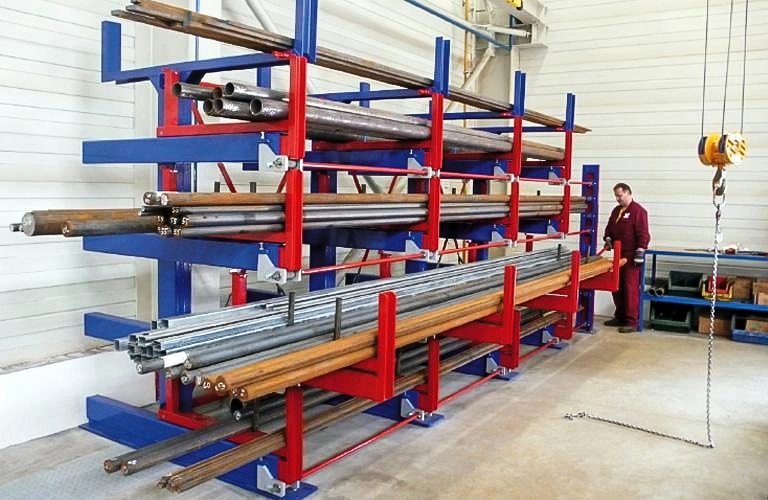
When a telescopic cantilever rack has four, five, or six storage levels, the upper arms sit well above head height — sometimes 3 meters or more off the ground. Reaching those levels safely and efficiently is the job of the chain drive system. This guide explains how chain drives bring high-level rack operation down to a comfortable, ergonomic working height, eliminating ladders, platforms, and fall risk.
The Problem: Upper Levels Are Out of Reach
Every telescopic cantilever rack uses a rack and pinion mechanism to extend and retract each cantilever arm. The operating handle connects to a transmission shaft that turns the pinion gear. On the lowest levels, this handle sits at a natural working height — roughly waist to chest level. But as you move up the rack, the transmission shaft for each level rises with it.
On a five-level rack, the top level’s transmission shaft might be 3.5 meters above the floor. Without a chain drive, the operator would need to climb a ladder or use a man-lift platform every time they need to access that level. That means:
- Slower cycle times (climbing up and down for every pick)
- Fall hazard — one of the leading causes of warehouse injuries
- Need for additional equipment (ladders, platforms, harnesses)
- OSHA compliance complications under fall protection standards
The Solution: Chain Drive Transmission
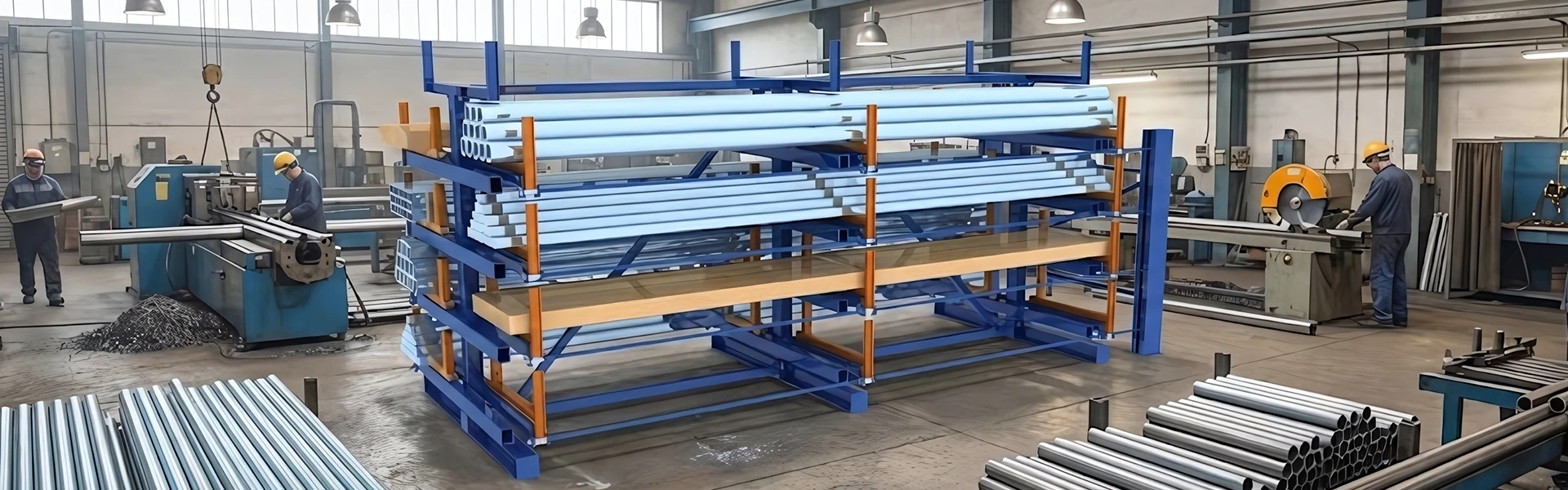
The chain drive is an elegantly simple power transmission system. Here is how it works:
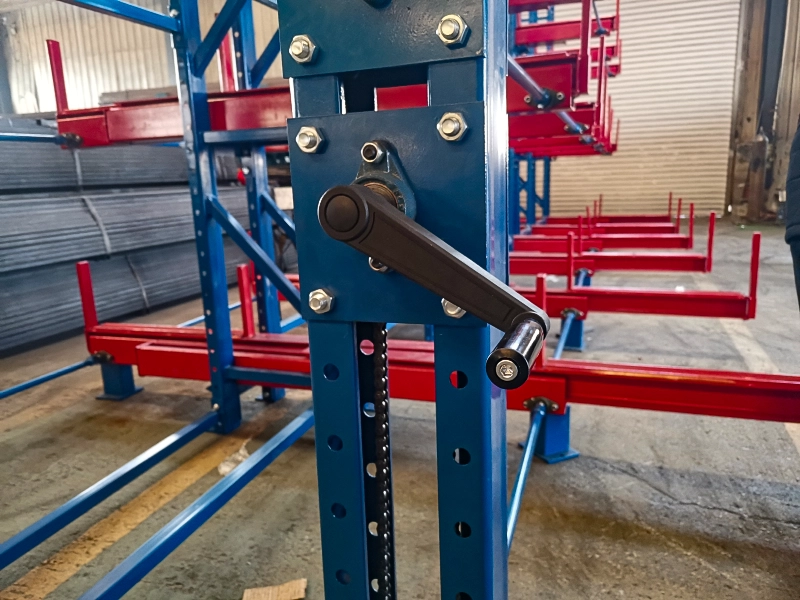
1. Chain wheel (sprocket) at the top: A sprocket is mounted on the transmission shaft of the upper-level arm, inside the upright column.
2. Roller chain: A standard industrial roller chain connects the upper sprocket to a lower sprocket or drive coupling.
3. Drive point at ergonomic height: The lower end of the chain connects to a handle coupling positioned 1.2 m to 1.5 m above the floor — comfortable standing height for most operators.
4. Operator turns the handle: Rotating the handle at floor level turns the lower sprocket, which pulls the chain, which turns the upper sprocket, which rotates the transmission shaft, which drives the pinion gear, which extends the arm.
The entire force path — from the operator’s hand to the cantilever arm three meters overhead — is mechanical, with no electrical components, no hydraulics, and no compressed air. It works in any environment, including outdoor yards, cold storage, and facilities without reliable power.
Why Chain Drive Instead of Other Methods?
Chain vs. Belt Drive
Timing belts are common in light-duty applications, but they stretch under heavy loads and degrade in dusty, oily industrial environments. Roller chains are rated for much higher tensile loads, resist contamination, and can be re-tensioned or replaced link by link without special tools.
Chain vs. Extended Shaft
An alternative would be to extend the transmission shaft all the way down to floor level with universal joints. This works for two or three levels but becomes impractical for taller racks — the shaft would need multiple support bearings, and the accumulated torsional flex over 3+ meters would make operation feel spongy. Chain drive keeps the mechanical path short and direct at each level.
Chain vs. Electric Motor
Electric motors are available as an upgrade for high-frequency operations, but the chain drive system remains valuable even on motorized racks. The motor simply replaces the manual handle at the lower drive point — the chain still transmits power to the upper levels. And if the motor fails or power is lost, the operator can revert to manual cranking through the same chain path.
Engineering Details That Matter
Chain Specification
CFS telescopic racks use industrial-grade roller chain (typically ANSI #60 or equivalent) rated for the maximum torque generated when extending a fully loaded arm. The chain is pre-tensioned during installation and includes a tensioner mechanism to compensate for wear over time.
Sprocket Alignment
Misaligned sprockets cause accelerated chain wear, noise, and eventual chain derailment. During installation, technicians use laser alignment tools to ensure the upper and lower sprockets are perfectly coplanar. This is especially critical on the TE Rack (assembled series), where the double-upright structure requires precise bracket positioning.
Lubrication
The chain requires periodic lubrication — typically monthly in normal operating conditions. The maintenance procedure is straightforward: clean off old grease and accumulated metal dust, then apply fresh lithium-based grease. Applying new grease over contaminated old grease creates an abrasive paste that accelerates wear on both the chain and sprockets.
Integration with Synchronous Transmission
The chain drive works in concert with the synchronous transmission shaft that connects all uprights on the same level. The chain brings the drive force down to floor level at one upright; the transmission shaft distributes that force horizontally to every other upright in the bay. The result: one operator, one handle, one motion — and a 12-meter arm extends perfectly parallel across all uprights.
Operational Benefits
- Zero climbing: Every level of the rack is operable from standing position on the warehouse floor. No ladders, no platforms, no fall risk.
- Faster cycle times: Eliminating the climb-up/climb-down step saves 2–3 minutes per operation on upper levels. Over a full shift with 30+ picks, that adds up to over an hour of recovered productivity.
- Single-person operation: One operator can access any level without assistance. No need for a spotter or a second person to hold a ladder.
- OSHA compliance simplified: By keeping the operator on the ground at all times, the chain drive system eliminates the need for fall protection equipment, guardrails, or elevated work permits for routine storage operations.
- Consistent force feel: The gear ratio through the chain and sprocket system provides smooth, consistent mechanical advantage. The operator feels roughly the same resistance whether operating level 1 or level 5.
When Do You Need a Chain Drive?
Chain drives are standard on any rack with three or more storage levels. For two-level racks, the upper arm’s transmission shaft is typically still within comfortable reach (around 2 m), so a direct handle connection is sufficient. The decision matrix:
- 1–2 levels: Direct handle connection (no chain needed)
- 3–4 levels: Chain drive on upper levels, direct handle on lower levels
- 5–6 levels: Chain drive on all levels above level 2, or full electric motor drive with chain transmission
For facilities with very high throughput (50+ operations per shift per level), electric motors with chain transmission are recommended to reduce operator fatigue. See our comparison of manual vs. electric operation.
Maintenance Checklist for Chain Drive Systems
Weekly: Visual inspection — check chain tension, look for kinks, rust, or damaged links.
Monthly: Clean and re-lubricate chain, sprockets, and bearing housings. Check sprocket teeth for wear.
Quarterly: Measure chain elongation. Replace the chain if elongation exceeds 3% of original pitch length.
Annually: Full inspection of sprocket alignment, chain tensioner condition, and all mounting hardware. Replace worn sprockets (they should always be replaced as a set with the chain).
For the complete maintenance schedule covering all rack components, see our maintenance and inspection guide.
Planning a Multi-Level Storage System? Let us help you specify the right drive configuration.