The Engineering Behind 100% Extension
Telescopic cantilever racks solve a fundamental problem in heavy material storage: how to access materials stored deep within a rack without using a forklift to pull them out. The answer is a mechanical system that extends the entire arm — and its load — out from the rack structure, exposing the material for overhead crane pickup. Here’s exactly how it works.
Core Mechanism: Chain-Driven Telescopic Extension
The telescopic arm consists of two nested sections: a fixed outer housing attached to the upright column, and a sliding inner section that extends outward. The inner section rides on guide rollers within the outer housing, similar to a drawer slide but engineered for multi-ton loads.
A roller chain connects the crank mechanism (or electric motor) to the inner arm section. When the operator turns the crank, the chain pulls the inner section outward along the guide rails. The gear reduction system (typically 1:40 to 1:60 ratio) multiplies the operator’s input force, allowing a single person to move several tons of material with moderate effort.
Step-by-Step Operation Sequence
1
Pre-Operation Safety Check
Operator verifies the aisle is clear, overhead crane is positioned, and no personnel are in the extension zone. Checks that the arm to be extended is not obstructed by adjacent arms or materials.
2
Release Safety Lock
Remove the safety pin that locks the arm in the retracted position. This pin prevents accidental extension during non-operation periods.
3
Extend the Arm
Turn the crank handle clockwise (or press the extend button on motorized systems). The arm slides outward on guide rollers until it reaches 100% extension. End stops prevent over-travel. Extension time: 1-3 minutes (manual) or 20-60 seconds (motorized).
4
Crane Access
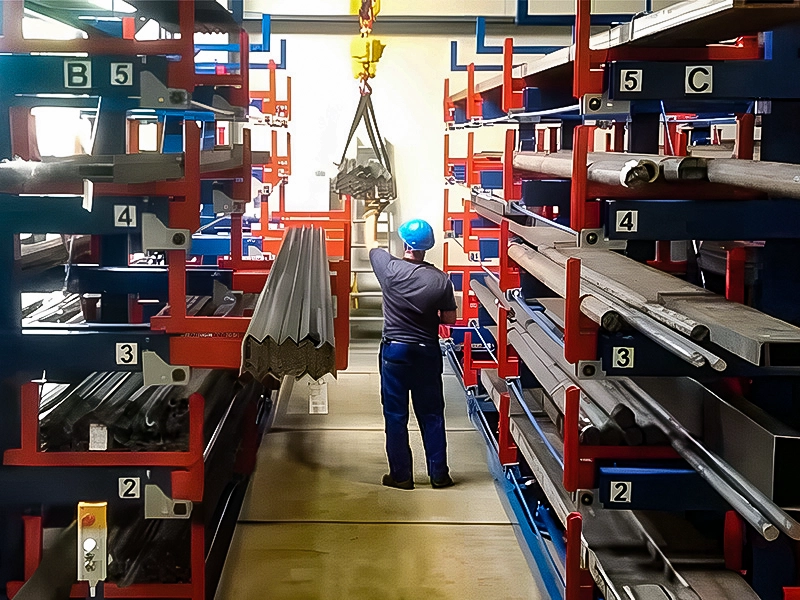
With the arm fully extended, the stored material is completely exposed and accessible to the overhead crane. The crane operator can pick up or deposit material directly — no forklift needed, no double-handling.
5
Retract and Lock
After crane operation is complete, turn the crank counter-clockwise to retract the arm. Once fully retracted, re-insert the safety pin. The arm and its remaining materials are now safely stored within the rack footprint.
Key Engineering Principles
GEAR REDUCTION
The 1:40-1:60 gear ratio means for every 40-60 turns of the crank handle, the arm moves one full revolution of the drive sprocket. This trades speed for force — a 10kg input force becomes 400-600kg of pulling force on the chain, easily moving multi-ton loads.
SELF-LOCKING
Worm gear reducers are inherently self-locking — the load cannot back-drive the mechanism. This means the arm stays exactly where you stop cranking, even under full load. No brakes or holding devices needed.
Three Safety Red Lines
Tcrack systems are designed around three non-negotiable safety principles derived from OSHA standards and real-world incident analysis:
🚫
RED LINE #1
Never stand under an extended arm or suspended load. The extension zone is a no-personnel area during operation.
🚫
RED LINE #2
Never exceed rated arm load capacity. Overloading causes structural failure, arm deflection, and potential collapse.
🚫
RED LINE #3
Never operate without safety locks engaged when not in active use. Unsecured arms can extend unexpectedly from vibration or accidental contact.