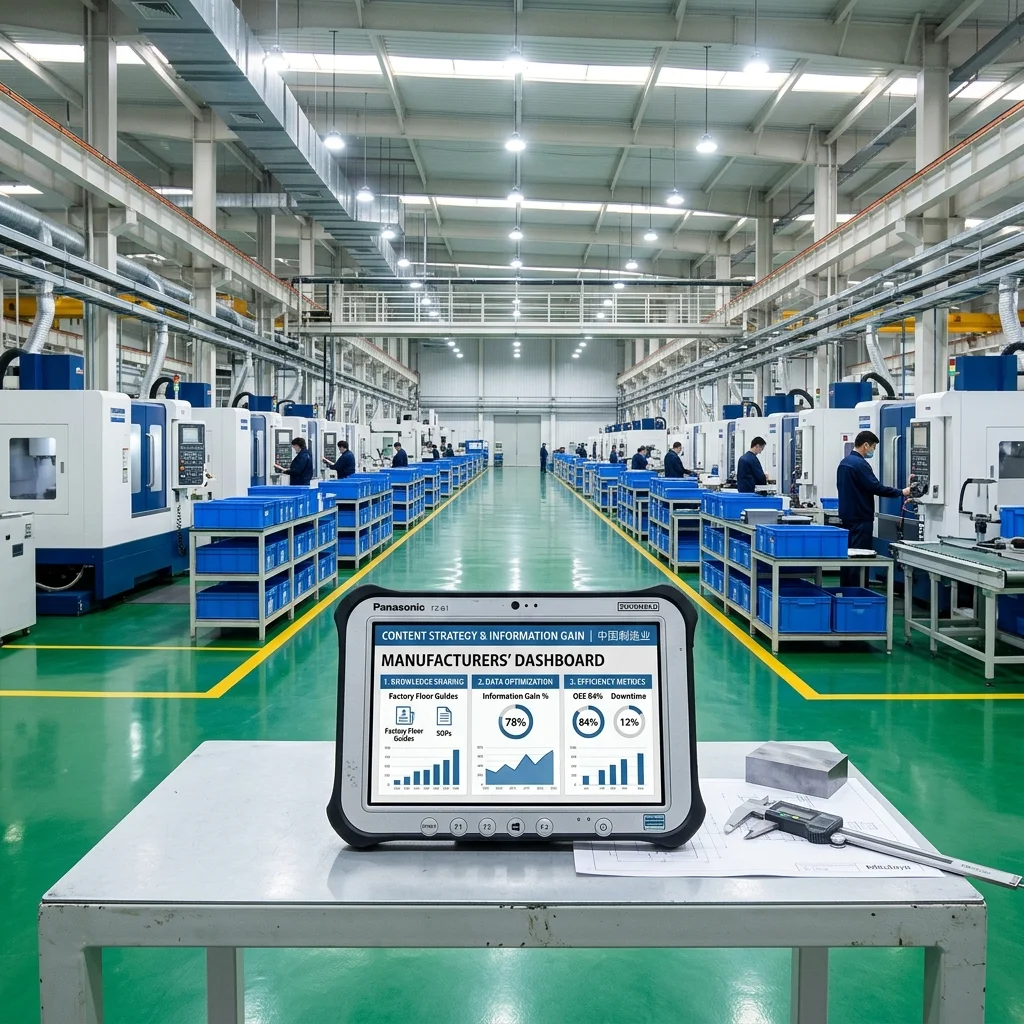
If your industrial website is just repeating the same definitions and processes as your competitors, you are losing organic traffic. Google’s algorithm now aggressively rewards “Information Gain” — content that adds new, unique value to a topic rather than summarizing existing web pages. For manufacturers, this means your marketing must shift from writing high-level overviews to publishing raw data, proprietary testing results, and highly specific engineering insights. In this article, we explain how to calculate your information gain score and how to restructure your technical content to win more RFQs.
What is Information Gain in B2B Manufacturing?
Information Gain is a machine learning concept where search engines evaluate whether a new page provides information that is not found in the existing top-ranking results. If an engineer searches for “injection molding defects” and your page simply lists “warp, sink marks, and flash” just like the top 10 results, your page has a net-zero information gain. It will not rank.
To rank, you need to provide something new. For example, a failure analysis report comparing two specific types of resins under stress, or a proprietary case study detailing how you reduced cycle time by 15%. This is the kind of content that demonstrates B2B website best practices.
How to Audit Your Content for Information Gain
| Content Type | Low Information Gain (Avoid) | High Information Gain (Publish) |
|---|---|---|
| Capabilities Pages | “We offer precision CNC machining services for aerospace.” | “Our 5-axis machines maintain tolerances of +/- 0.0001 inches on Inconel 718.” |
| Case Studies | “We helped a client save money and time.” | “We reduced scrap rate by 22% using a custom mold flow analysis.” |
| Blog Posts | “What is Sheet Metal Fabrication?” | “Comparing Bend Allowances: Aluminum 5052 vs. Stainless Steel 304.” |
A Checklist for Enhancing Your Industrial Website
- Interview Your Engineers: Marketing teams cannot create information gain alone. Interview your production managers to extract real-world problem-solving stories.
- Publish Internal Data: Share your anonymized material testing results, quality control statistics, and defect rates. Data is the ultimate unique content.
- Stop Relying on LLMs for Primary Research: AI content is killing industrial website rankings because AI can only synthesize existing information; it cannot generate new engineering data.
- Create Tooling Comparisons: Write detailed comparisons of specific manufacturing methods for particular applications based on your facility’s experience.
The Business Impact of Unique Technical Data
When you provide high information gain, you do not just please search engines; you build trust with procurement teams. An engineer evaluating suppliers will always choose the one that demonstrates the deepest technical understanding of their specific problem.
Not sure if your website meets the 2026 standard?
Run our free 30-second website check.
Free Website Check